


What Are Investment Securities?
Investment securities are assets that investors buy and hold to generate income or achieve capital appreciation. These financial instruments play a fundamental role in personal and institutional portfolios, offering potential for wealth growth, risk management, and diversification. Understanding the types of investment securities available can help investors make informed choices to achieve specific financial goals.
How to Calculate Return on Investment Securities?
To assess the profitability of investment securities, the annualized return formula provides a measure of percentage gain or loss over a set period, allowing comparisons across asset classes. Here’s a basic formula:

Annualized Return = (Ending Value − Beginning Value + Dividends Received / Beginning Value) ×100
This formula enables investors to evaluate securities’ performance and make informed decisions regarding portfolio adjustments.

Why are Investment Securities Important?
Investment securities offer a strategic approach to building wealth by balancing growth, income, and risk. By selecting a mix of equities, debt, and hybrid securities, investors can align their portfolios with long-term financial goals and optimize their investment strategies in diverse market conditions.
Importance of Investment Securities for Banks
One of the core benefits of investment securities for banks is their liquidity. These securities can be quickly converted into cash or sold in the market if needed, offering banks flexibility in managing their balance sheets. This liquidity ensures that banks can respond promptly to cash flow needs, enabling them to maintain a stable financial position.
Investment securities also contribute to capital gains. When sold, they can generate realized capital gains, providing an additional revenue stream. This is especially significant for investment-grade securities, which can produce higher returns due to their lower risk profiles. These profits help boost the overall financial health of the bank and contribute to its ability to lend and engage in other financial activities.
In essence, investment securities are integral to banks’ portfolios, providing both immediate and long-term financial benefits. From offering liquidity to supporting capital gains, and even serving as collateral, these assets allow banks to navigate market fluctuations, meet regulatory requirements, and optimize returns. Their significance in the broader banking and financial landscape cannot be overstated, as they offer a dynamic tool for managing risk and enhancing profitability.
Regulatory and Risk Considerations
While investment securities offer clear financial benefits, they are also subject to capital restrictions. Banks are limited in how much they can invest in certain types of securities, particularly those issued by state governments or other institutions. For instance, regulations often restrict investment in Type II securities to no more than 10% of the bank’s total capital and surplus, ensuring a well-balanced portfolio that mitigates risk.
Furthermore, investment securities can serve as collateral for various banking obligations. In some cases, investment-grade securities help banks meet pledge requirements for government deposits, enhancing their ability to maintain relationships with regulatory authorities and other financial institutions.
Types of Investment Securities
Investment securities come in three main categories, each with distinct characteristics, benefits, and risk profiles:
Equity Securities
Equity securities, primarily stocks, represent ownership in a company. When investors buy stocks, they become partial owners and may receive dividends as part of the company’s profit distribution. Equity securities offer high growth potential, as their value can rise significantly if the company performs well. However, they are also subject to market fluctuations and generally carry higher risk.
Debt Securities
Debt securities include bonds and other fixed-income instruments. By purchasing debt securities, investors essentially lend money to corporations, governments, or other entities in exchange for regular interest payments and repayment of principal at maturity. These securities are often less volatile than stocks, though their risk varies depending on the issuer’s credit rating. For example, U.S. Treasury bonds are considered low-risk, while corporate bonds can offer higher yields at greater risk.
Hybrid Securities
Hybrid securities blend characteristics of both equity and debt. Examples include convertible bonds, which can be converted into company shares at a future date, and preferred stocks, which offer consistent dividends like bonds but may also appreciate in value. Hybrids provide an intermediate level of risk and are suitable for investors seeking regular income with some growth potential.
Benefits of Investment Securities
Investment securities serve various functions in a balanced portfolio, such as:
Income Generation: Bonds and other fixed-income securities provide regular payments, creating a steady cash flow for investors.
Capital Appreciation: Equity securities, in particular, have the potential to grow in value over time, increasing the overall worth of a portfolio.
Diversification: A diversified portfolio of stocks, bonds, and hybrids can reduce risk by balancing growth with stable income.
How to Find Investment Securities?
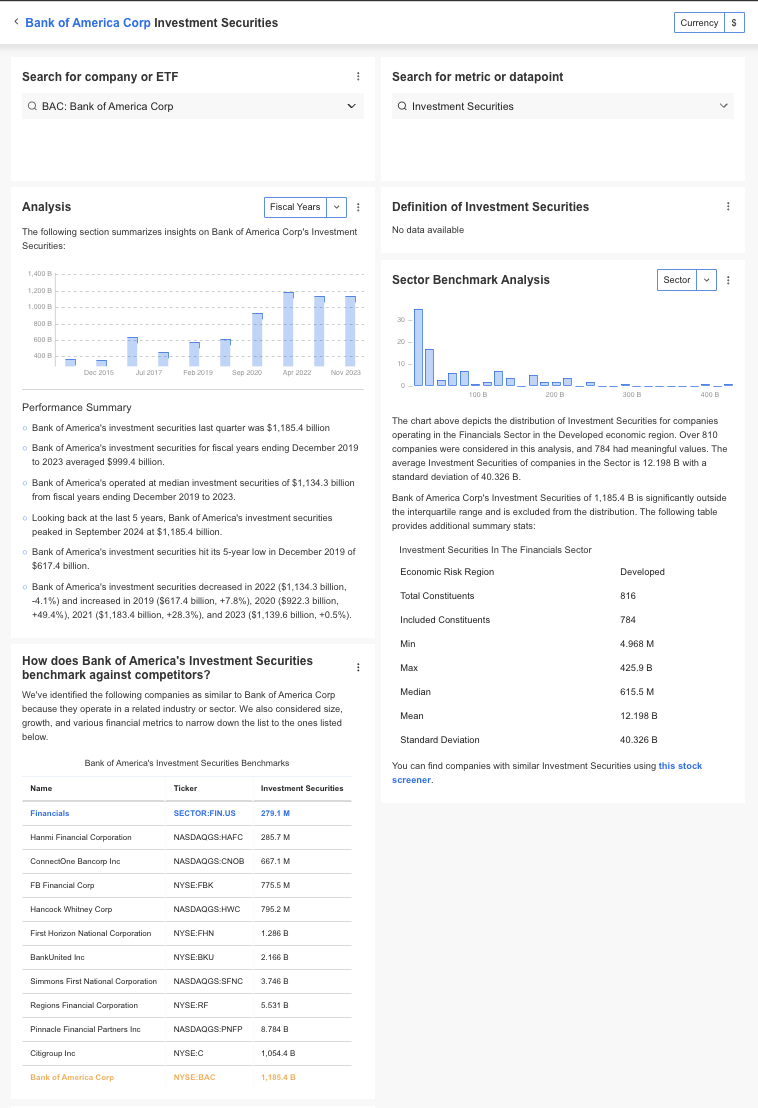
InvestingPro offers detailed insights into companies’ Investment Securities including sector benchmarks and competitor analysis.
InvestingPro: Access Investment Securities Data Instantly
Unlock Premium Data With InvestingPro 📈💸
Gain instant access to Investment Securities data within the InvestingPro platform
🛠️ Access to 1200+ additional fundamental metrics
🔎 Competitor comparison tools
📊 Evaluate stocks with 14+ proven financial models
Investment Securities FAQs
How do investment securities diversify a portfolio?
Investment securities allow investors to balance risk by combining various asset classes. For instance, when stocks decline, bonds may hold their value or even rise, reducing potential losses.
Are investment securities liquid?
Many investment securities, like publicly traded stocks and bonds, are liquid assets, meaning they can be easily bought or sold on exchanges.
How do investment securities differ from loans?
While loans are typically arranged through direct agreements between the borrower and lender, investment securities are usually purchased through a third-party broker or dealer. Investment securities can be traded more easily than loans, offering greater liquidity and flexibility for investors.
What are the risks of investment securities?
Investment securities carry risks, including market risk for equities, credit risk for bonds if issuers default, and interest rate risk that affects fixed-income assets.
How are investment securities valued?
Investment securities are typically valued at their amortized book value, which is calculated by subtracting the accumulated amortization from the original cost. This valuation method allows banks and investors to track the value of securities over time.




 App Store
 Google Play